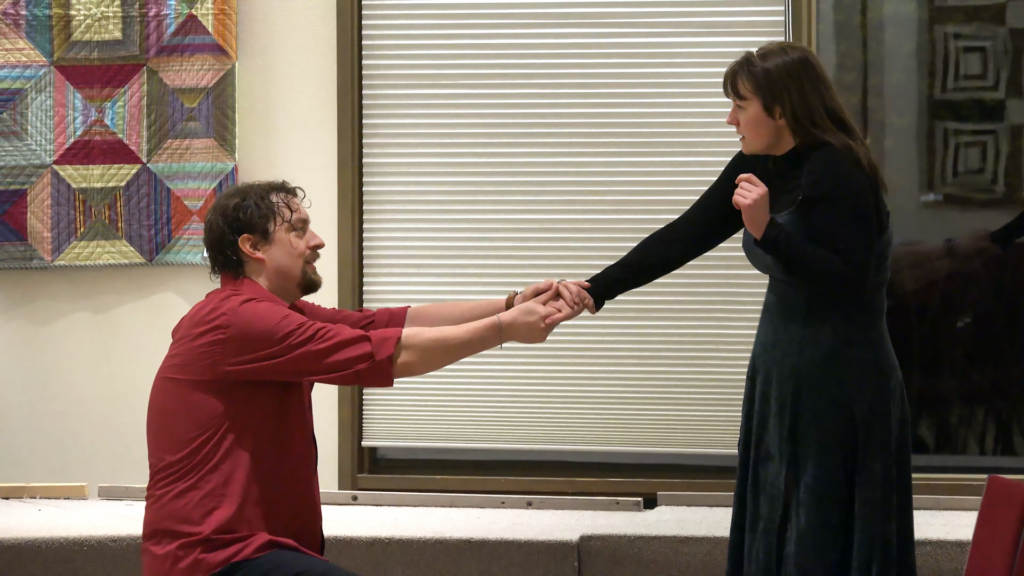
Let’s say you took Shakespeare’s “The Taming of the Shrew,” that beloved but endlessly controversial comedy, and stripped away the subplots to focus on the storyline in which Petruchio sets out to “tame” Katherina, the “shrew,” in ways that are increasingly cruel and abusive.
Rachel Kohler of the Corvallis Justice Theatre did just that to craft “The Blaming of the Shrew,” her unorthodox adaptation of “Shrew,” which will be performed Friday and Saturday at 7:30 p.m. at the Unitarian Universalist Fellowship, 2945 NW Circle Blvd. in Corvallis.
Kohler, who’s also directing the production, reports that the first half-hour or so of her “Blaming” is “just a straight-out comedy.” After that, though, the show transforms into something considerably less comfortable as Petruchio (Chad Howard) subjects Katherina (Sanaya Forbes) to tortures such as starvation and sleep deprivation.
Fun, right?
Overall, Kohler said in a recent interview, “We hope that the experience will be a little awkward and uncomfortable.”
And thought-provoking as well. That’s why this brisk production will leave time at the end for audience discussion.
In creating her version of “Shrew,” Kohler has drawn not only from the Shakespearean text that appears in the First Folio, but a related play that was making the rounds at about the same time (the 1590s) called “Taming of a Shrew.” Scholars have long debated the link between the two plays: Which one came first? Is “A Shrew” based on “The Shrew,” or vice versa? Is “A Shrew” crafted from memories of people who saw Shakespeare’s show?
Shakespeare’s version begins with an introductory section – it’s called the “induction” – in which a nobleman tricks a drunkard, Christopher Sly, into believing that Sly is a nobleman as well. The mischievous nobleman then has a play staged for Sly’s amusement – and this play within a play tells the story of Katherina and Petruchio.
But this framing device “just kind of trails off in Shakespeare’s play,” Kohler said – it only shows up again near the end of the first act. “The frame is never closed. In the other text, the framing device does have an epilogue, and that was a primary reason I wanted to conflate both texts.”
“A Shrew” also features an additional sister for Katherina, which allowed Kohler to add another female role.
Kohler’s work of stripping down the story to its basic plotline resulted in a fast-paced show.
“We wanted it to be snappy, because a lot of our Justice Theatre performances are pretty quick, because we always have conversation after the play,” she said. “By combining the two texts and then chopping out pretty much all the comical love subplots, it makes it very streamlined and makes the progression of abuse really obvious.”
Staging the play in the Unitarian Universalist Fellowship building allows for that after-show conversation, Kohler said.
Like previous Justice Theatre productions, “Blaming of the Shrew” is intended in part as a fundraiser. Proceeds from the show will go to Keep Our Clinics, a nonprofit organization that offers support to independent, community-based clinics that provide abortion services, often in rural areas.
Kohler sees a clear connection between “Shrew” and the work of Keep Our Clinics. “Misogynistic comedy is part of how the patriarchy retains control,” she said, citing as an example new restrictions on abortion rights in the wake of the U.S. Supreme Court ruling in Dobbs v. Jackson.
“Blaming of the Shrew” should appeal to audiences “who are curious about weirder, offbeat theater products that happen in Corvallis,” Kohler said – and people who are interested in a new take on a well-known tale.
“It’s going to be a lot of fun,” she said, “until, like, the last half-hour.”
If You Go
WHAT: “The Blaming of the Shrew,” a production of Justice Theatre
WHEN: Friday, March 31 and Saturday, April 1, at 7:30 p.m.
WHERE: Unitarian Universalist Fellowship, 2945 NW Circle Blvd. in Corvallis
HOW MUCH: Pay what you can. You can reserve tickets at brownpapertickets.com or make donations at the door.




0 Comments